OSINT and Additional Intelligence Types
There are several other types of intelligence, namely Human Intelligence (HUMINT), Signals Intelligence (SIGINT), Geospatial Intelligence (GEOINT). The following sections will describe each of them and highlight the comparisons between them and OSINT.
Human Intelligence (HUMINT)
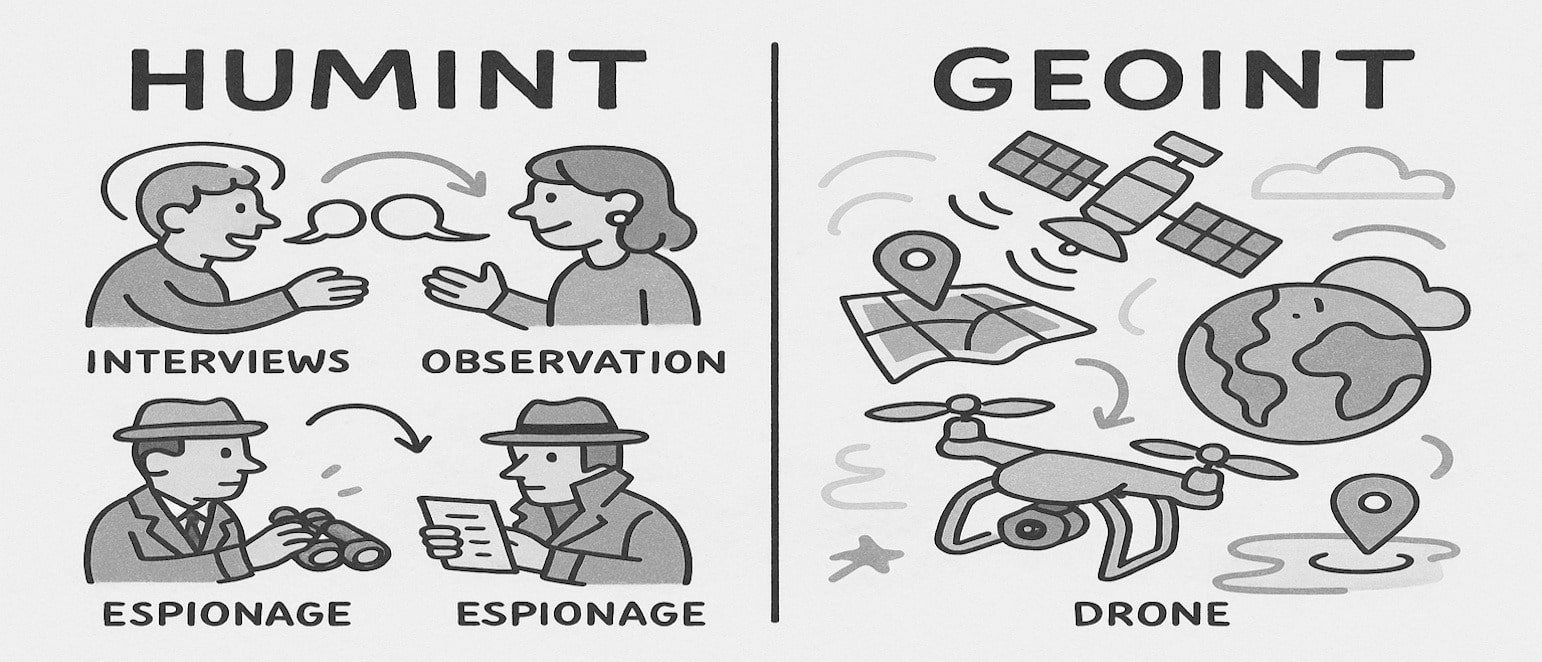
- Through direct engagement with people, informants and sources on the ground, Human Intelligence (HUMINT) collects intelligence by gaining insights from individuals who have firsthand expertise.
- There are differences between OSINT and HUMINT, firslt OSINT gathers information from publicly available sources while HUMINT is dependent on confidential human sources such as in-person contacts, interviews and covert activities.
- HUMINT can provide deeper insights into human intentions, motivations and interpersonal relationships, whereas OSINT excels in real-time monitoring and large-scale data analysis.
- OSINT tends to have fewer human biases and is less resource intensive compared to HUMINT.

Signal Intelligence (SIGINT)
- Signal intelligence (SIGINT) refers to the collection and analysis of electronic signals such as communications, radar emissions, and data transmissions. It often involves the interception and decoding of radio communications, emails and other electronic signals, playing a critical role in monitoring the activities of foreign governments, military forces and potential adversaries.
- There are key differences between OSINT and SIGINT; OSINT relies on openly available data, while SIGINT focuses on the interception of communications and electronic signals.
- SIGINT provides insights into classified communications and covert activities, whereas OSINT offers a broader understanding of publicly available information and global trends.
- OSINT operates within the public domain, while SIGINT often involves sensitive or classified information and requires strict adherence to legal frameworks and privacy considerations due to its methods of data collection.


Geospatial Intelligence (GEOINT)
- Geospatial Intelligence (GEOINT) combines imagery and geospatial data such as satellite imagery, aerial photographs, and geographic information systems (GIS) data to provide visual representations of geographic features, activities and changes over time. GEOINT is essential in military planning, disaster response, urban planning, and environmental monitoring.
- There are key differences between OSINT and GEOINT; GEOINT focuses on the visualization and analysis of geospatial data, while OSINT focuses on information gathered from publicly available sources.
- GEOINT relies primarily on imagery and spatial data, whereas OSINT covers textual, multimedia, and digital information from open sources.
Open Source Intelligence (OSINT) is a valuable discipline that complements and intersects with the other intelligence types mentioned above. Each intelligence field has its own unique strengths and methodologies, providing a multi-dimensional and well-rounded understanding of the global landscape. By understanding OSINT’s foundations and its relationship with other intelligence disciplines, organisations and analysts can make more informed, data-driven decisions in an increasingly complex digital world.